Use case
Make knowledge visible, avoid duplicate work
Make internal improvements visible so teams can find solutions earlier, adopt them, and avoid duplicate work.
Many teams solve similar problems more than once because useful internal improvements get lost in chats, tickets, or project tools.
Chirm gives these updates a visible place in one shared timeline. Anyone who has built, improved, or simplified something can share it briefly. Other teams see earlier what already exists, can ask follow-up questions asynchronously, and adopt proven solutions instead of starting from scratch again.
Good fit for
Who benefits
Team leads, functional leaders, and cross-functional teams
Problem: Useful internal improvements often stay invisible
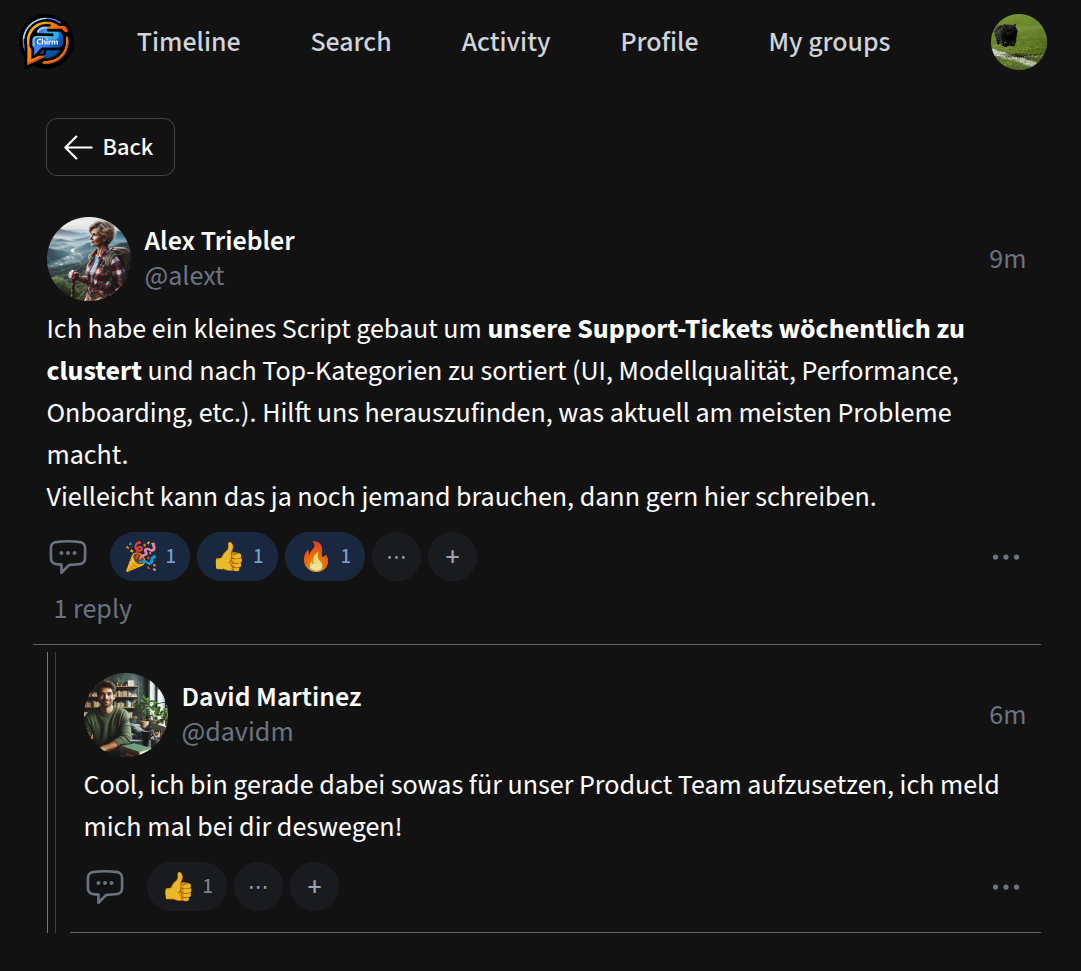
A support team builds a small internal tool that groups recurring tickets, highlights trends, and saves time every week.
The problem is not the quality of the solution. The problem is its visibility.
When these kinds of improvements only appear in tickets, documents, or isolated chats, other teams often never see them — even though they could benefit from them directly.
That leads to similar work being done again somewhere else.
"We already built that."
If that sentence comes too late, it costs time and money.
How this works with Chirm
- 1
A team or individual employee implements a useful improvement
- 2
They share a short update in Chirm: What was done, why it is useful, and where to find more details
- 3
Other teams see the update in their timeline and can react or ask follow-up questions asynchronously
- 4
Additional information, documentation, or responsible contacts are linked directly in the post
- 5
The solution is adopted or adapted instead of being rebuilt
- 6
Later, the update can be found again through search
Before and after
| Without Chirm | With Chirm | |
|---|---|---|
| Internal improvements | Stay buried in chats, tickets, or individual knowledge | Become visible in the shared timeline |
| Cross-team discoverability | Depends on chance | Is structured and searchable |
| Reuse | Happens late or not at all | Happens faster and more intentionally |
| Follow-up questions | Are spread across multiple tools | Stay bundled directly with the post |
Who this is relevant for inside the organization
Teams with practical improvements
Anyone who creates a useful tool, simplification, or better way of working can make it visible so others can benefit from it.
Engineering, Operations, and Support
See existing solutions, workflows, and helpful tools earlier and reuse them instead of building similar things in parallel.
Leadership and management
See where useful improvements are emerging across the organization and how reuse creates real value.
Relevant Chirm features
- Personal timeline for relevant internal updates
- Groups and topics for clear categorization
- Replies and reactions for easy follow-ups
- Search for long-term discoverability
Example KPIs for a 90-day pilot
| KPI | Observation question | What progress looks like |
|---|---|---|
| Shared improvements | How many relevant internal improvements are being made visible during the pilot? | Regular posts from multiple teams |
| Cross-team engagement | How often do these updates lead to reactions, follow-up questions, or discussion? | Initial engagement across team boundaries |
| Reuse | How often are shared solutions adopted or adapted by other teams? | Several documented examples of reuse |
| Avoided duplicate work | Where was similar work avoided or shortened because an existing solution was visible? | Initial traceable examples of time saved |
4-week rollout plan
- 1
Week 1: Define two to three groups and involve the first teams
- 2
Week 2: Teams publish their first posts about practical improvements
- 3
Week 3: Review interactions and collect first examples of reuse
- 4
Week 4: Share an interim metrics update and involve additional teams
FAQ for rollout teams
Do we need another project management tool for this?
No. Chirm does not replace project tools. It makes relevant internal updates visible across teams so other teams can discover and use them.
Is this only meant for official top-down company communication?
No. Chirm is not just for messages from leadership. Teams and individual employees can also easily share useful internal improvements when they could be relevant to others.
How do we avoid adding more noise?
Clear group assignments, short posts, and relevant updates instead of constant chatter help reduce unnecessary noise.
What if a team needs more detail?
The post stays short and focused. Documentation, additional links, and responsible contacts are linked directly below it.
Who should share these kinds of updates?
Any team or employee who has made a useful improvement, created a helpful tool, or found a better way of working that could benefit others. What matters is not hierarchy, but whether the update is relevant beyond one team.