Use case
Get new employees up to speed faster
Give new hires a structured starting point from day one: curated context for their role, a personal timeline of relevant team updates, and a clear way to confirm they have read what matters.
New employees arrive without knowing what they do not know. Useful context lives in old email threads, wikis, and documents, none of which are organized for someone who just joined.
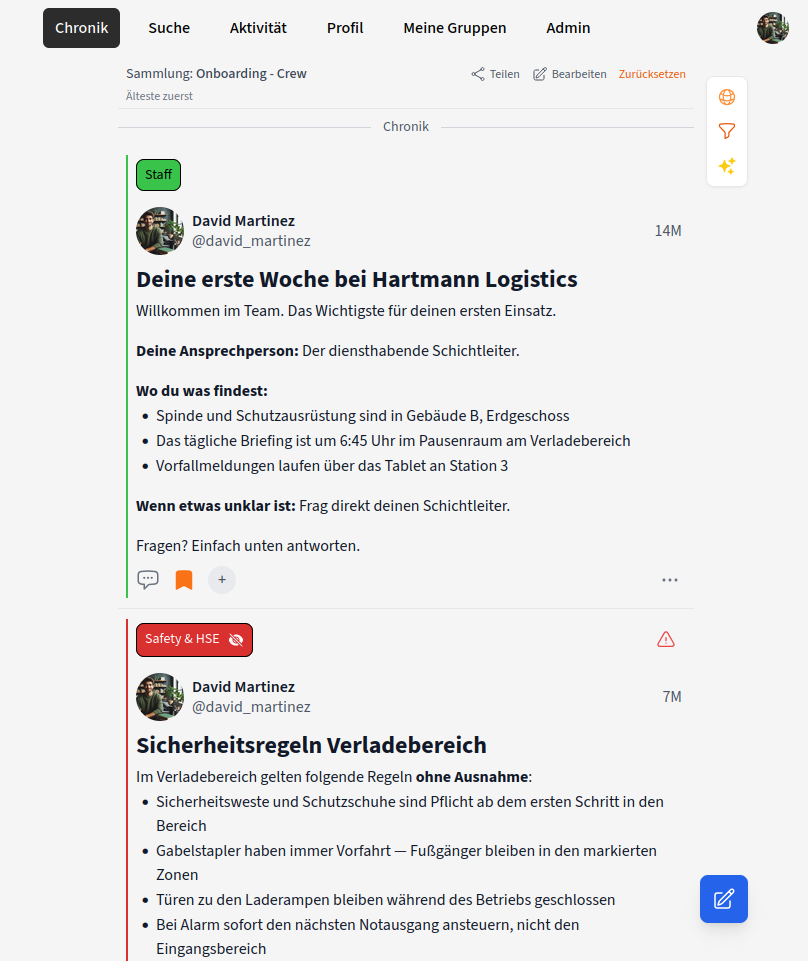
Chirm gives onboarding a structured home. A curated collection of the most important posts, a personal timeline scoped to the new hire's actual role and team, and built-in confirmation for policy reads mean that getting up to speed no longer depends on someone remembering to tell them everything.
Good fit for
Who benefits
HR, people operations, team leads, and managers
Problem: Useful context exists but is not organized for someone new
A new hire joins the team. There is plenty of relevant information: team procedures, key contacts, how decisions get made, which tools are used and why, what not to do.
The problem is not that the information does not exist. The problem is that it is scattered.
It lives in a wiki that nobody updates, in old Slack threads that require knowing what to search for, in documents shared informally, or only in the heads of people who have been around long enough to know.
New hires spend their first days asking where to find things instead of getting to work.
"I spent the first two weeks figuring out who to ask."
That time could have been spent on actual work.
How this works with Chirm
- 1
HR or the team lead creates an onboarding collection with the most important posts: role context, team procedures, key contacts, and required reading
- 2
The new hire is added to the relevant groups and immediately gets a personal timeline showing only what is relevant to their role and team
- 3
The onboarding collection gives them a structured starting point so they can read at their own pace without asking around
- 4
Follow-up questions stay attached to the relevant post as reply threads, not in a separate conversation
- 5
Once onboarded, the timeline continues to show relevant team updates so the new hire stays informed naturally
Before and after
| Without Chirm | With Chirm | |
|---|---|---|
| Onboarding material | Scattered across wikis, emails, and informal handovers | Curated collection ready from day one |
| Relevant information | New hire gets everything or nothing, depending on who they ask | Personal timeline scoped to their actual role and team |
| Policy confirmation | Manual tracking or simply assumed | Acknowledgment recorded per person with timestamp |
| Follow-up questions | New messages to HR or manager, context lost | Reply thread attached directly to the relevant post |
| Long-term findability | Depends on memory or knowing where to look | Searchable across all groups the employee belongs to |
Who this is relevant for inside the organization
New employees
A clear starting point on day one: the most important context for their role, organized in one place, with no need to ask around for things that should already be findable.
HR and people operations
Structured onboarding material that can be reused for every new hire, with a visible confirmation record for required reading and no manual tracking.
Team leads and managers
New hires catch up faster and ask fewer orientation questions. More time for actual work from the start.
Compliance teams
Confirm that new employees have read and acknowledged required policies before they start working independently.
Relevant Chirm features
- Collections: curate the most important posts into a structured onboarding set, ready to share with every new hire
- Personalized timeline: new hires see only posts relevant to their groups and topics from the moment they join
- Groups: add new hires to the right teams, departments, and locations so their feed is accurate from day one
- Requiring acknowledgment: mark policy posts and required reading so new hires must confirm they have read them
- Reply threads: follow-up questions stay attached to the relevant post rather than starting a new conversation
- Search: new hires can find context on their own once they know what to look for
Example KPIs for a 90-day pilot
| KPI | Observation question | What progress looks like |
|---|---|---|
| Orientation questions | How many questions do new hires direct to HR or their manager in the first two weeks? | Fewer repetitive orientation questions during pilot onboardings |
| Policy acknowledgment | What share of new hires confirm required reading before starting independent work? | Full confirmation on record within the first week |
| Collection engagement | Are new hires actually reading the onboarding collection? | High read rate on curated posts across pilot cohort |
| Perceived clarity | Do new hires feel they had a clear starting point? | Positive feedback in end-of-onboarding check-ins |
4-week rollout plan
- 1
Week 1: Identify the most important things every new hire needs to know and create an onboarding collection covering each one with a short, focused post
- 2
Week 2: Add the first new hire to the relevant groups, share the onboarding collection, and mark required policy posts for acknowledgment
- 3
Week 3: Collect feedback from the new hire on what was missing or unclear, and add any gaps to the collection
- 4
Week 4: Hand the collection off to HR or team leads for ongoing use and measure acknowledgment rates and orientation question volume
FAQ for rollout teams
Does this replace our wiki or employee handbook?
No. Your existing documentation stays where it is. Chirm handles the communication and confirmation layer: making sure new hires find and read the most relevant posts without someone manually walking them through everything. Links to existing documentation can be added directly inside posts.
What if different roles need different onboarding material?
Create a separate onboarding collection per team or role. Each collection contains only what is relevant to that specific group, and you share it with the people who need it.
How do we keep onboarding content up to date?
The collection owner can add, remove, or update posts at any time. When something changes, a new post can be added to the collection or shared with existing members of the relevant group.
Can we require new hires to confirm they have read a policy?
Yes. Posts marked as requiring acknowledgment must be explicitly confirmed with a single tap or click. Chirm tracks who has confirmed and when, so you always know where things stand.
What about questions from new hires?
New hires can ask follow-up questions directly in the reply thread of the relevant post. That keeps context together instead of starting a separate message that loses the connection to the original content.
Can an onboarding collection accidentally expose posts a new hire should not see?
No. Collections respect existing group permissions. If a post is included in a collection but the new hire does not belong to the group it was published in, they will not see that post. Sharing a collection never grants access beyond what the recipient is already allowed to view.
Can we see whether a new hire has read the onboarding material?
For posts with required acknowledgment, yes: the record shows who confirmed and when. For posts without mandatory confirmation, Chirm does not track individual reads by design, consistent with its privacy-first approach.