In development
Help AI-generated updates reach the right people, with approval and acknowledgment
AI systems can prepare updates from inventory, quality management, HR, or IT. We are developing Chirm so these updates reach the right employees, clearly labeled as AI-generated, with human approval and a traceable acknowledgment record.
AI agents can identify recalls, deviations, and upcoming deadlines in business systems. Getting that information to employees is a separate step: people in stores, wards, or production facilities may not have a mailbox or regular access to Teams. Important updates still need a responsible person and a clear record of who has acknowledged them.
This extension of Chirm is in development. The foundation already exists: targeted delivery, acknowledgments, reminders and connections to external systems. We are looking for pilot partners to decide with us how AI-generated updates should reach their employees.
Good fit for
Who benefits
Operations, quality management, IT and internal communications
Problem: Automated updates need clear ownership and acknowledgment
As more systems generate updates automatically, employees may receive more notices across different channels. Three questions need clear answers:
- Noise: How does the important safety instruction stay visible next to ten automated notices?
- Source: Did a person write this or a system, and on whose behalf?
- Accountability: Who reviews and approves the update, and who confirms they have read and understood it?
"The agent detected the recall. But has everyone in the affected branch acknowledged the instruction?"
Without targeted delivery and acknowledgment, it is hard to know whether an automated update has reached the right people.
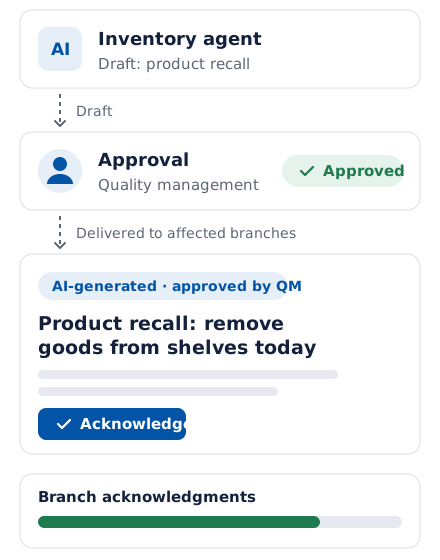
Planned workflow with Chirm: a product recall
- 1
Detect
An agent in the inventory system detects a supplier recall and identifies which branches hold the affected batch.
- 2
Draft
The agent drafts a post requiring acknowledgment in Chirm, addressed only to the affected branches.
- 3
Approve
The responsible person in quality management reviews and approves the draft before publication. Critical posts require human approval.
- 4
Acknowledge
Employees see the recall instruction in their timeline and acknowledge that they have read and understood it with a single tap or click.
- 5
Follow up
After the deadline, Chirm would remind employees whose acknowledgments are still pending and, if needed, notify the regional manager.
AI updates today and the planned workflow in Chirm
| Agent posts to email or chat | Planned with Chirm | |
|---|---|---|
| Reach | Only employees with a mailbox or Teams license | Every employee with a personal timeline, mailbox or not |
| Audience | Distribution list or whole channel | Exactly the affected groups, sites or roles |
| Source | Bot account with no clear owner | Labeled agent with an accountable person |
| Approval | None, or outside the system | Human approval, depending on the type of post |
| Proof | Delivered does not mean read | Traceable acknowledgment per person |
Available Chirm features
- Required acknowledgment and critical posts: employees explicitly confirm they have read and understood an update
- Deadlines and reminders: follow up on pending acknowledgments without contacting each person individually
- Groups and topics: target updates at sites, shifts or roles
- External updates: bring content from other systems into Chirm through connectors and signed webhooks
- AI summaries: an optional summary of recent activity
What we are building with pilot partners
- Agents as authors: each agent with its own identity, an accountable person and clearly limited audiences
- Labels: every post shows which agent drafted it and who approved it
- Approval queue: an agent's critical posts and posts requiring acknowledgment go out only after human approval
- Posting limits: communication owners decide how many posts an agent may publish per week
- Decision requests: an agent asks a named person to approve or decline, with a timestamp
- Escalation: report pending acknowledgments to the next level once the deadline passes
- Translation and summaries: posts in each employee's language, with the original one tap away
Planned limits for AI agents
The planned agent features should support reliable communication while protecting employee privacy:
- No behavior tracking. No reading times, no activity scores, no profiles of individual employees.
- No acknowledging for others. An acknowledgment is always a deliberate tap or click by a person.
- No private content. Private messages and private groups stay closed to agents.
- Nothing unlabeled. Every post by an agent is recognizable as such.
- No critical posts alone. Safety and compliance notices require human approval.
These limits can be written into a works agreement before the first agent is connected.
Who this is relevant for inside the organization
Operations and branch management
Help system-generated updates reach employees and see who has acknowledged them and where follow-up is still needed.
Quality and safety
AI prepares the draft while approval stays with you. The planned record shows who drafted, who approved, and who acknowledged the update.
IT and digital transformation
One channel with clear rules for every agent, instead of each system sending its own notifications.
Works council
Clear, written limits on what AI may and may not communicate inside the company.
How to become a pilot partner
- 1
Identify the systems or agents that generate updates employees need to receive
- 2
Start with available features: Chirm with acknowledgments, and an existing system connected via webhooks
- 3
Agree together which posts need approval and which limits apply, with the works council if you wish
- 4
Be first to use and shape new features such as labels and the approval queue
Frequently asked questions
Does this exist yet?
Partly. Acknowledgments, reminders, groups, AI summaries, and connecting external systems via webhooks exist today. Agent identities, labels, the approval queue, decision requests, and translation are in development.
Is Chirm a platform for building AI agents?
No. Your agents are built where they are built today: in your business systems or your AI platform. Chirm is where their output reaches employees, with clear labels and a traceable acknowledgment record.
How will our AI agents connect to Chirm?
The planned connection uses an MCP server: a bridge that lets your AI agents prepare updates in Chirm. Your organization decides what the agents may do and which posts need human approval.
Does this replace Microsoft Copilot or Teams?
No. Chirm adds targeted delivery with acknowledgment to the tools you already have, especially for employees without a mailbox or Teams license.
Does an AI watch what employees do?
No. The planned approach gives agents access only to aggregated acknowledgment status per group or site, so they can remind or escalate. It excludes reading-time tracking and analysis of individual employees.
Where is data processed?
Chirm is hosted in the EU, and running it in your own data center is possible. Which AI models are used for translation and summaries is decided together with the pilot partners.